
TravCave — a founder-run digital-nomad ecosystem
Media portal, booking engine, coliving retreats and a YouTube channel for Russian-speaking digital nomads — our founder's own venture, built end to end.
- Client
- TravCave — our founder's own venture
- Sector
- Travel media · Community · Travel tech
- Scope
- Product · Engineering · Brand · Content · Events
- Team
- Founder-led, with a creative agency, an SMM designer and a film crew brought in at peaks
- Timeline
- 2022 → 2024 · portal → booking → retreats → media
- Reference
- travcave.ru
Audience figures come from the TravCave media kit (July 2024), covering June 2022 – July 2024. Product UI is in Russian — its home market.
Discuss your projectMost agency portfolios show client work. This one is different: TravCave was our founder’s own venture — Misha ran it under the title “Chief Adventurer,” and Startrise’s playbook for shipping products fast was largely written here. It’s the project where we were the client, the product team, the engineering team and the marketing department at the same time.
TravCave set out to be the home base for Russian-speaking digital nomads. The site introduced itself as the first portal of its kind in the Russian-speaking internet, and the ambition behind it was bigger than a blog: an ecosystem where content brings people in, tools keep them, and real-world trips turn readers into a community.
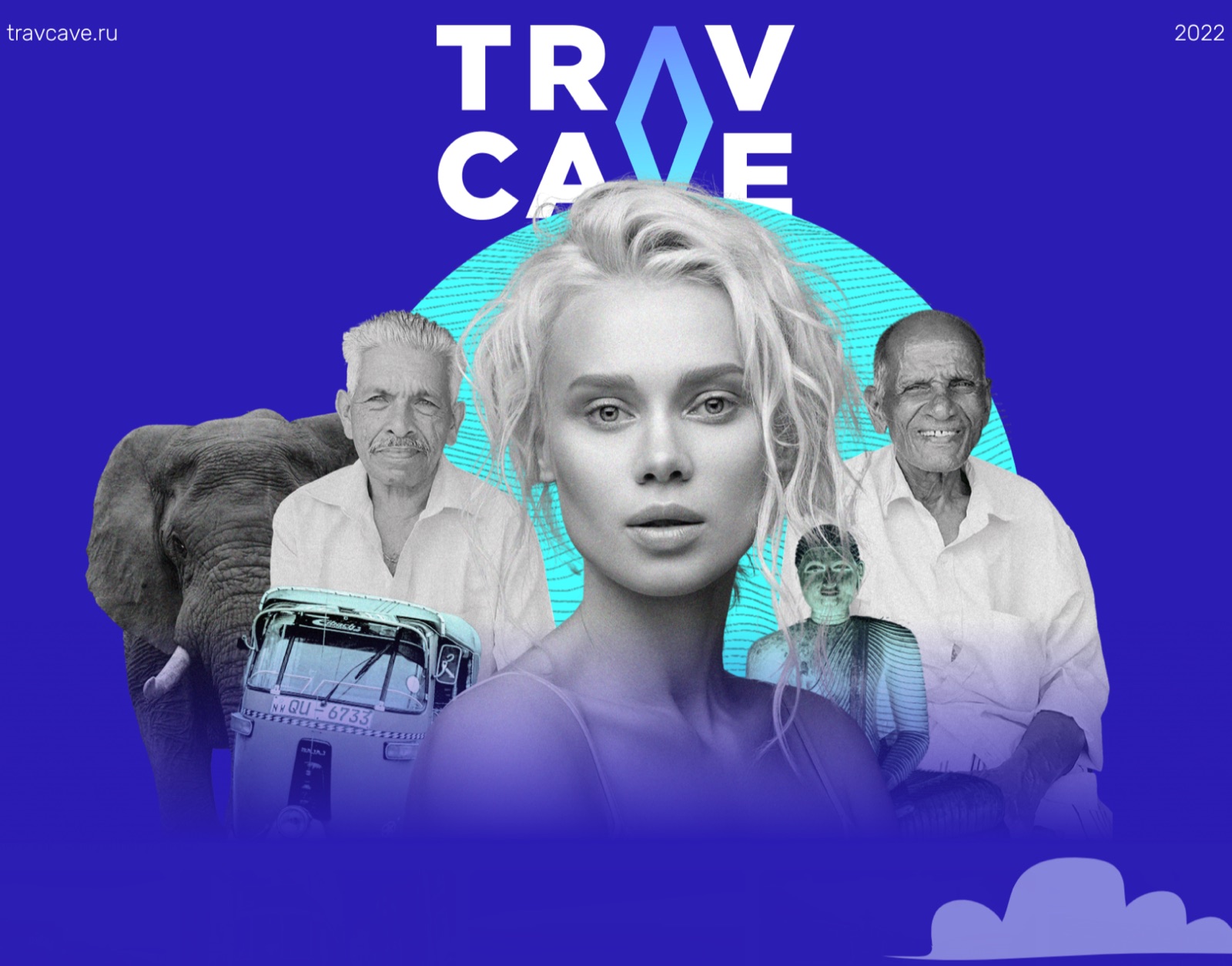 The 2022 brand: an electric blue world, monochrome people cut out of their contexts, and a diamond glyph inside the wordmark
One funnel, five products
TravCave wasn’t one website. It was five connected workstreams, each feeding the next:
- The portal (travcave.ru) — articles, news, city guides and community features
- TravCave Booking (book.travcave.ru) — flight and hotel search under the TravCave brand
- TravHouse (trip.travcave.com) — coliving/coworking trips, sold through their own acquisition site
- The YouTube channel — destination films, lectures and TravHouse episodes
- Social and email — Instagram, Telegram and an onboarding sequence that introduced every product above
A new subscriber got one welcome email that routed them to articles, booking, YouTube and upcoming trips. Nothing lived in isolation; every product cross-promoted the rest.
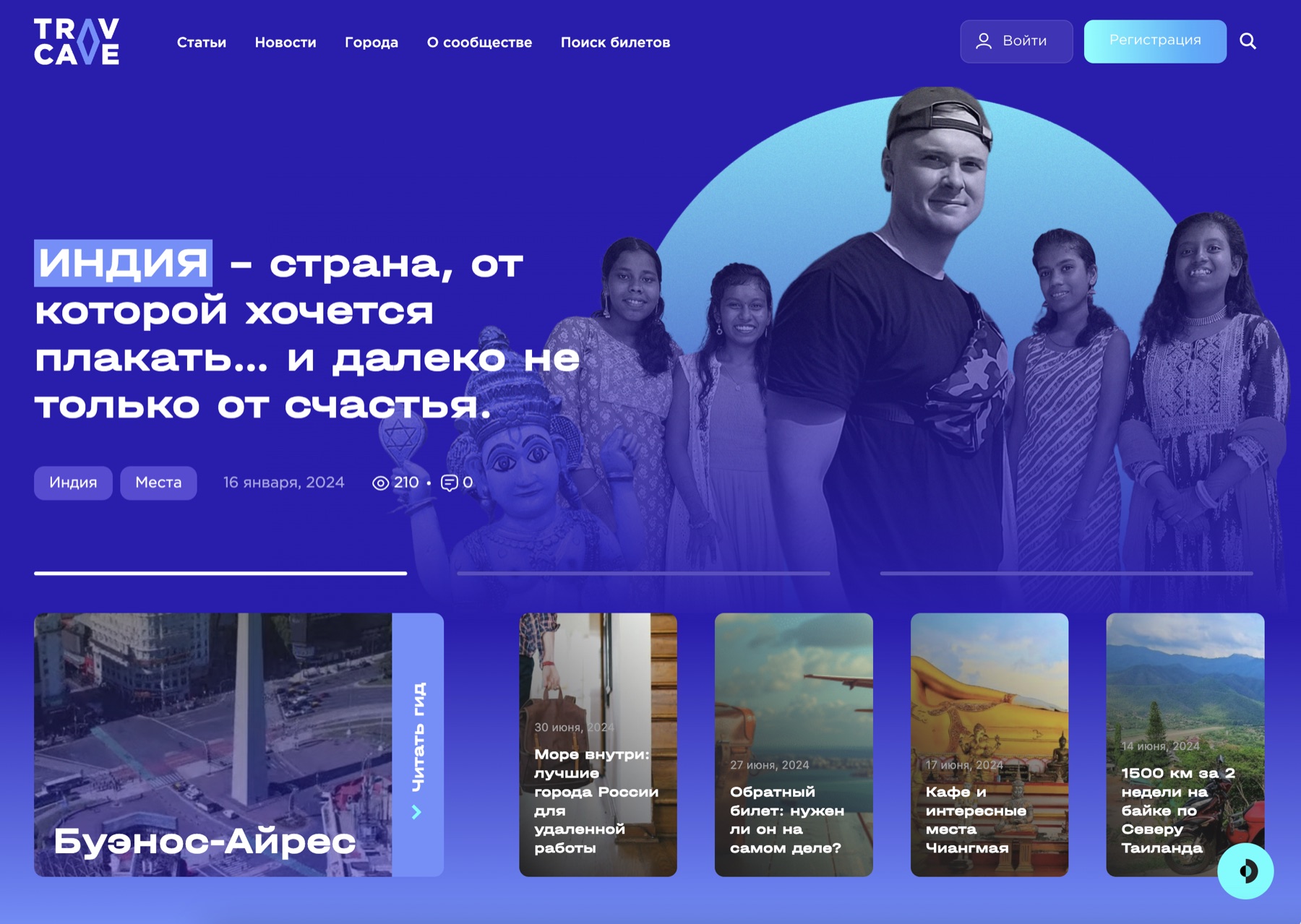 The portal’s homepage — bold Halvar-style display type, founder-written features, and the community’s stories up top
The portal: publishing plus community
Under the hood, travcave.ru was a custom WordPress product — a bespoke theme (travcave-buddyboss) with substantial hand-written PHP in the front page templates, Advanced Custom Fields powering structured editorial data, BuddyBoss providing the community layer, and custom Gutenberg blocks for editorial components like the “popular authors” module. Local development ran through DevKinsta, Docker and Nginx.
Members could register, publish their own stories and appear as authors alongside the editorial team — the tagline promised that anyone could become a blogger and tell their story. Article pages carried view counts, comments, category chips and author attribution, magazine-style.
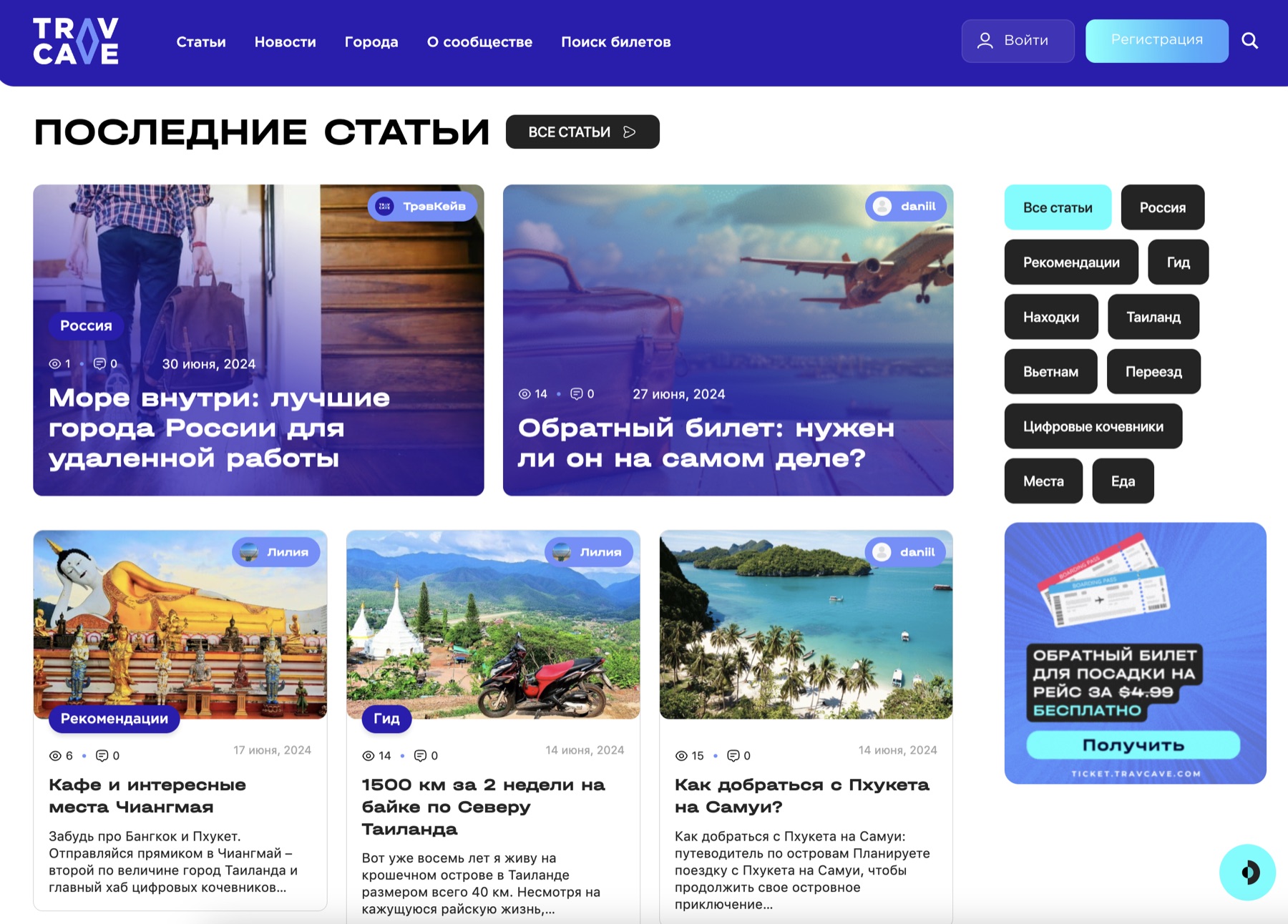 The articles hub — editorial and community posts side by side, filterable by destination and topic
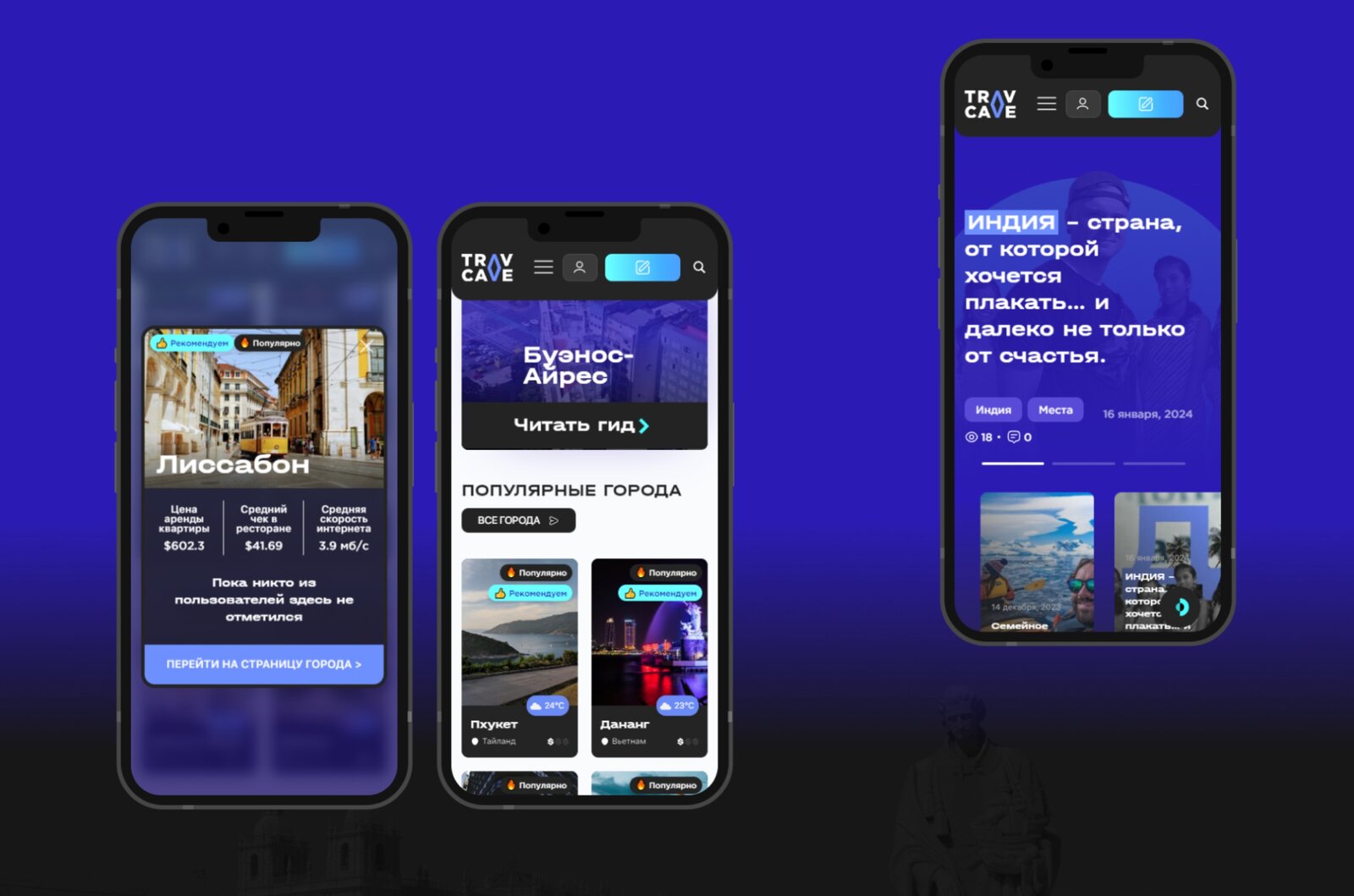
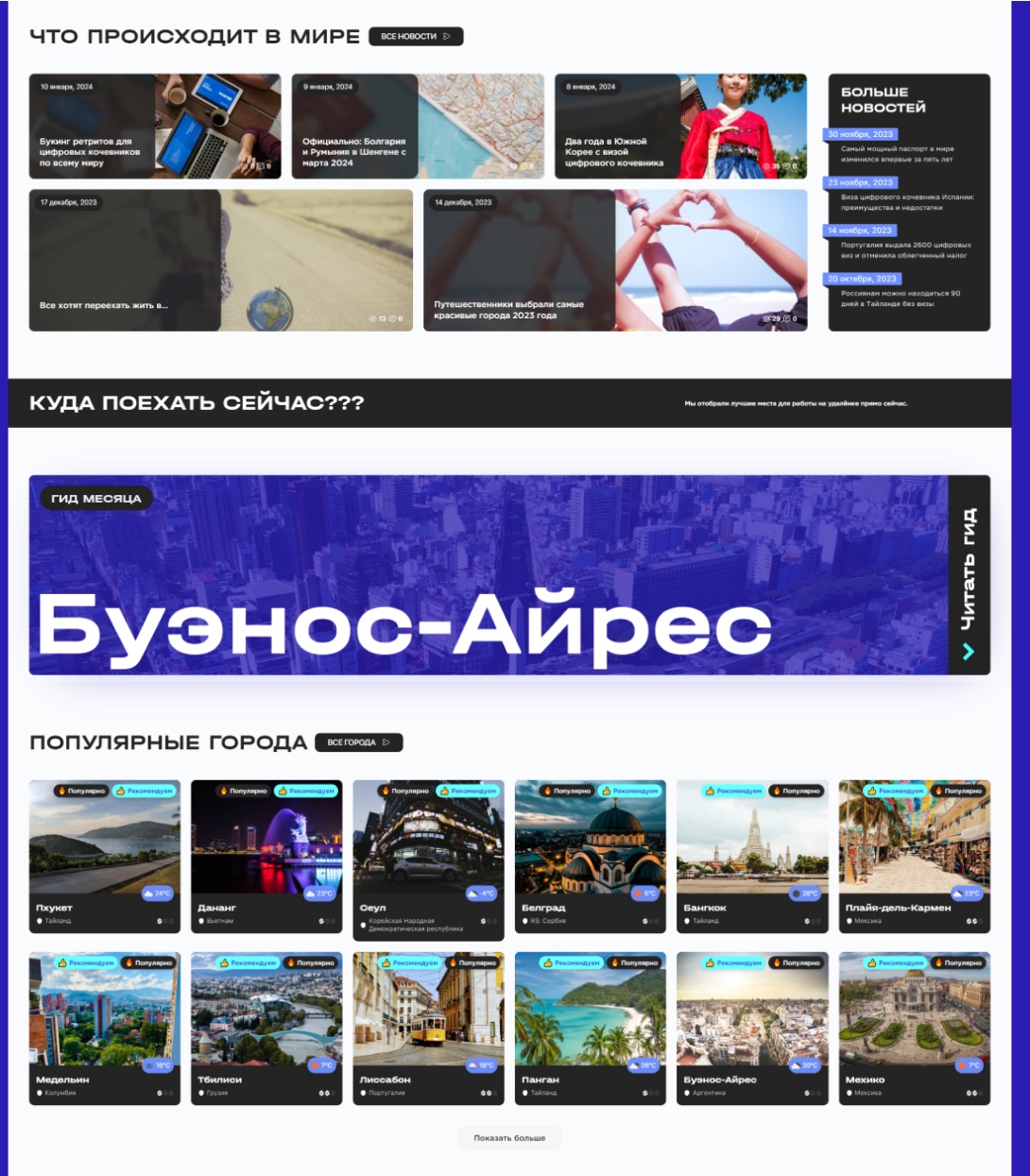 News, “Guide of the Month” and popular cities — every card pulls live data: weather, cost level, popularity flags
Cities as structured data
The decision that separated TravCave from every travel blog around it: cities weren’t articles, they were entities. Each city in the system carried structured fields — city_code, internet_speed, cost-of-living data, rent prices, average restaurant checks — plus imagery, descriptions and a live count of TravCave users currently checked into that city.
That data model paid off across the whole product:
- City pages rendered a stat strip (cost of living, rent, restaurant check, internet speed, local time, weather) over a hero image, followed by a map, a price breakdown, city history and related articles
- Weather came from the OpenWeather grouped-cities endpoint — one API call for many cities, cached in WordPress transients for about an hour, keyed by each city’s
city_code - Check-ins gave the community a location layer: a “Set Current City” button fired a
fetch()toadmin-ajax.php, swapped its label while processing, and updated the user’s city without a page reload — andget_users_checked_in_city()surfaced how many nomads were in each place right now
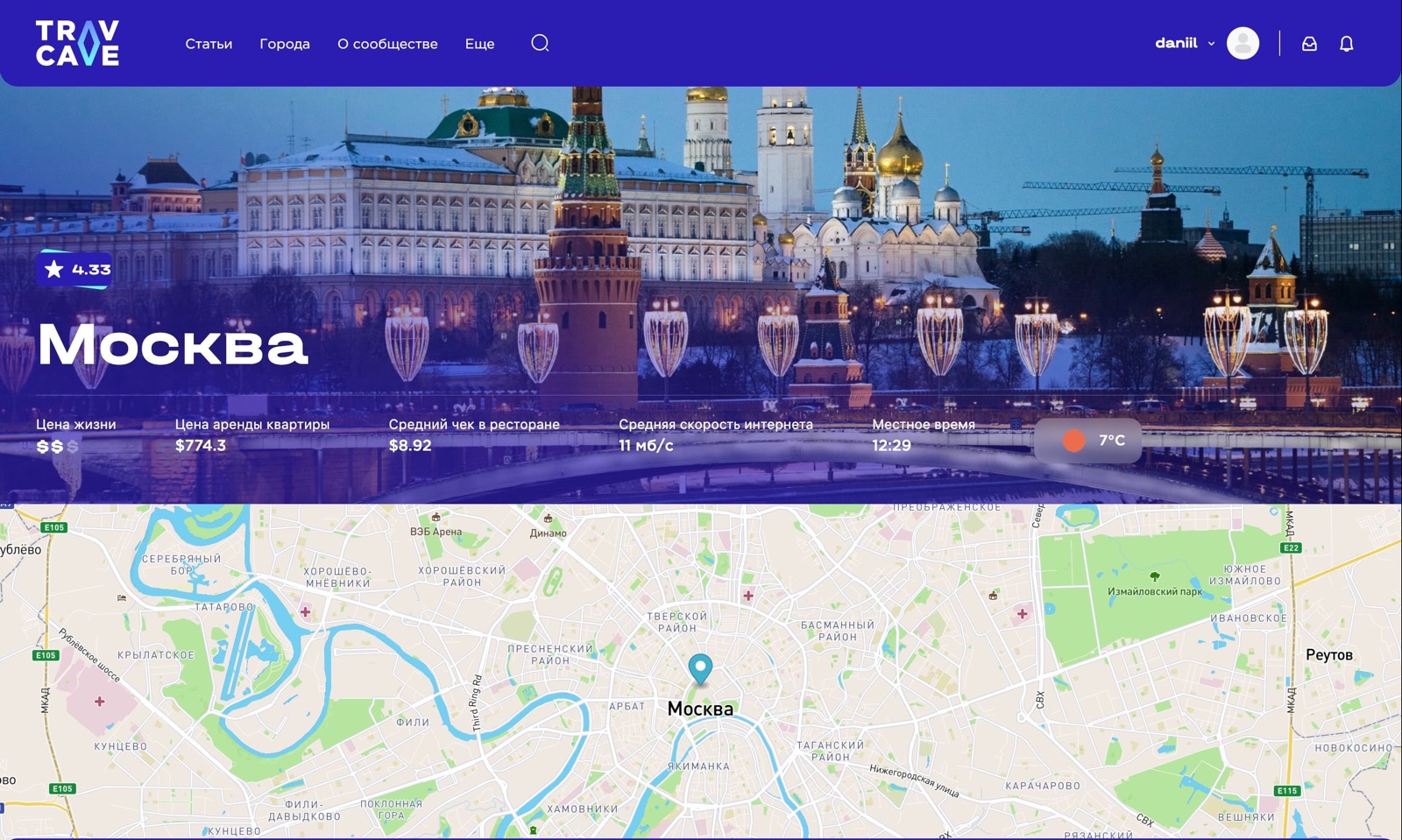 A city page: every number on the stat strip is a structured field, not copy — rent, average check, internet speed, live local time and weather
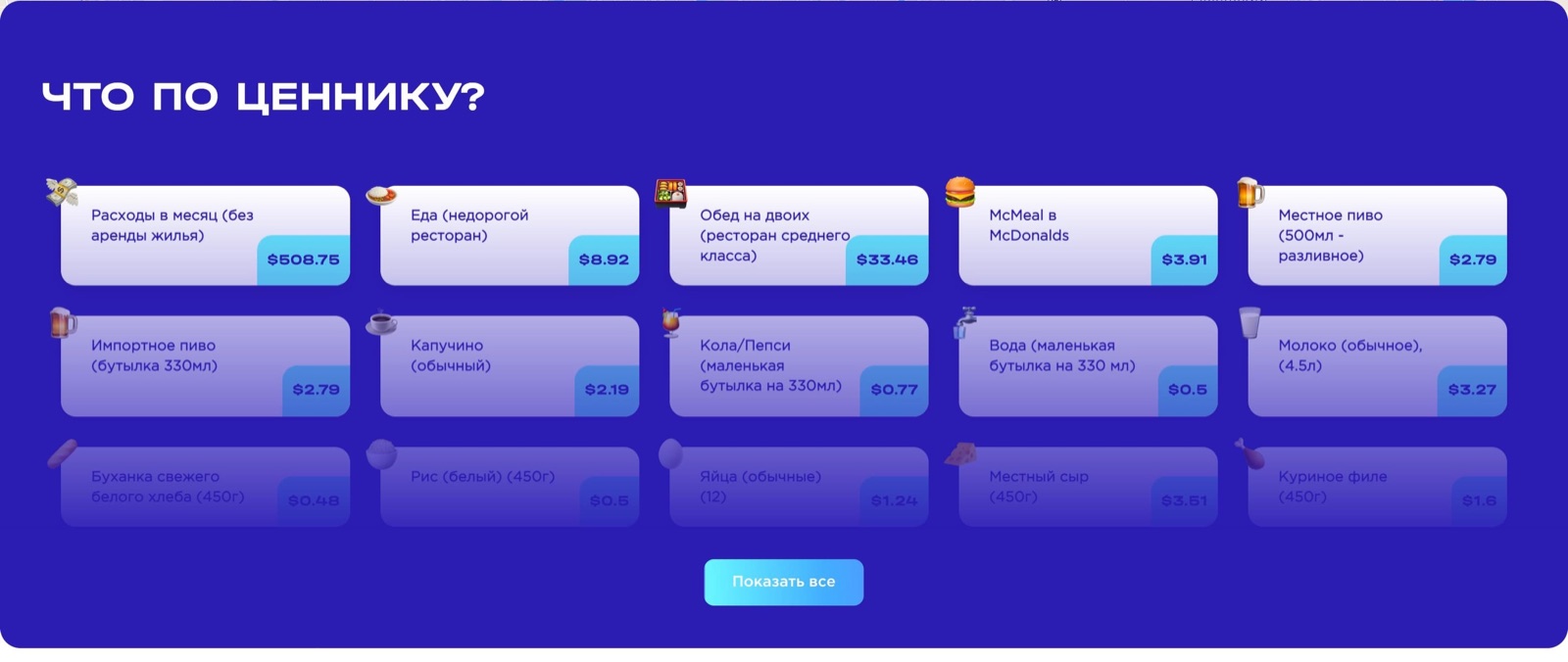 “Что по ценнику?” — the cost-of-living breakdown, rendered from the same city data model
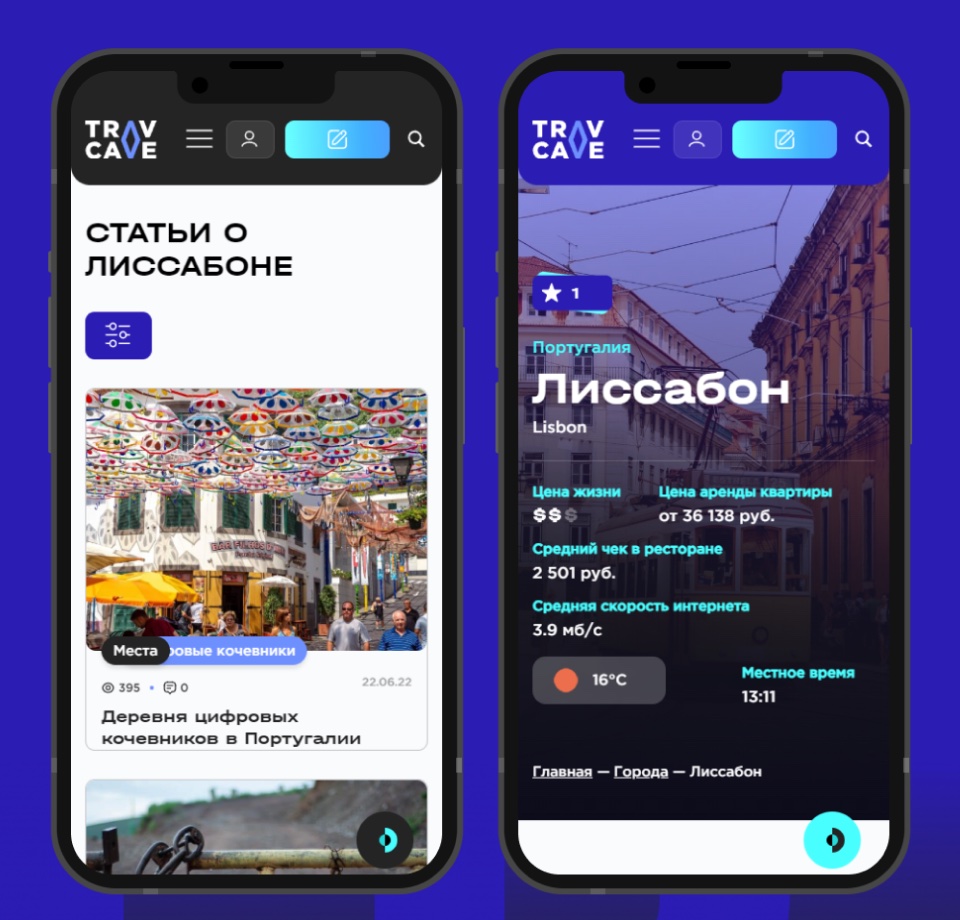 79% of the audience came on mobile, so the city stat strip was designed phone-first
An editorial system built for video
TravCave leaned hard on video. The “Guide of the Month” module — powered by ACF fields for the featured guide’s video, header and name — rendered a self-hosted HTML5 loop (autoplay, muted, playsinline, poster fallback, object-fit: cover) with the guide content overlaid. The wider front end used GSAP for animation, Glide.js for carousels, VenoBox for modal video and the YouTube IFrame API for embedded players.
We also instrumented what most content sites never measure: video engagement inside modals. VenoBox lifecycle callbacks plus YT.Player events fired GA4 events through gtag() — a video_start event carried the video’s name and ID, with a videoPlay cookie preventing double counting. TravCave could see which videos actually got watched, not just which pages got opened.
TravCave Booking: a white label that doesn’t feel like one
book.travcave.ru put a flight-and-hotel comparison engine inside the ecosystem — an Aviasales-powered white-label product underneath, deliberately presented as “TravCave Бронирование” with the vendor’s name kept out of customer-facing onboarding. The pitch was tuned to the audience: search hundreds of providers, pay with Russian or foreign cards, find stays that work for remote work.
Making a white label feel native took real work on two fronts:
- The skin — a custom header, responsive styling and the full brand treatment: Halvar Breitschrift for display type, Gotham Pro for interface copy, and positioning lines like “Твой спутник в мире бронирования!” written for the nomad use-case
- The SEO layer — hotel preview pages got a dynamic metadata template that assembled the title from hotel name, city, check-in/check-out dates and guest count (”…— Лучшие цены на отели | TravCave”), and populated meta descriptions, Open Graph and Twitter Card fields with Russian-locale values and dynamic share images. Booking pages became indexable, shareable objects instead of a generic embedded widget
A brand system across every surface
In 2023 the social presence got a systematic redesign — our founder directing, an independent designer executing. The Instagram feed moved from ad-hoc travel imagery to a modular grid: a defined layout grid with safe zones, an expanded palette anchored by the brand blues plus a cyan accent, and a carousel system where color and composition alternate card-to-card to keep swipe rhythm. A custom <>>> scroll glyph — a nod to “nomad digital” — replaced page numbers.
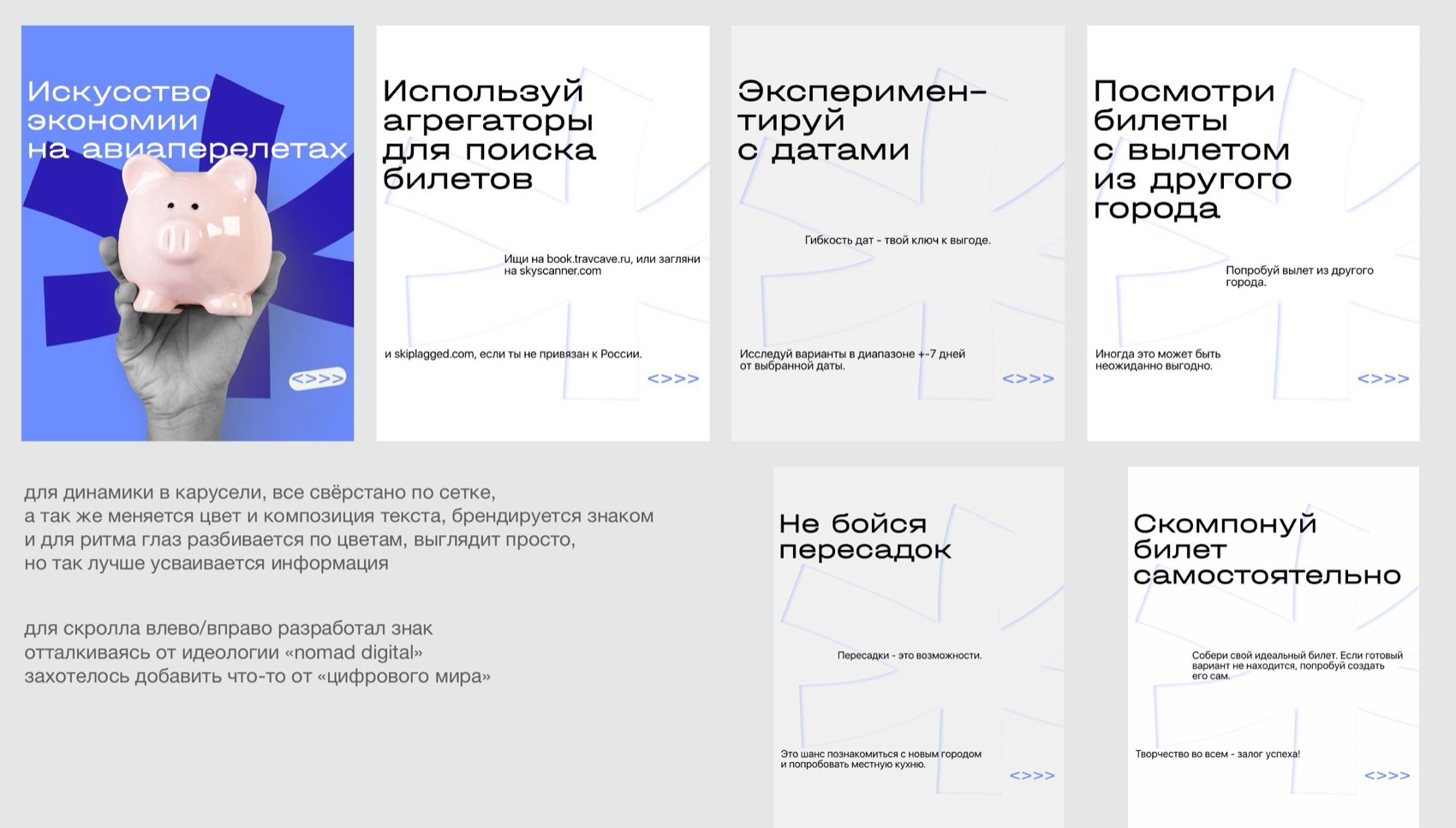 The carousel system from the working deck — everything on a grid, color and composition alternating for swipe rhythm, the custom scroll glyph bottom-right
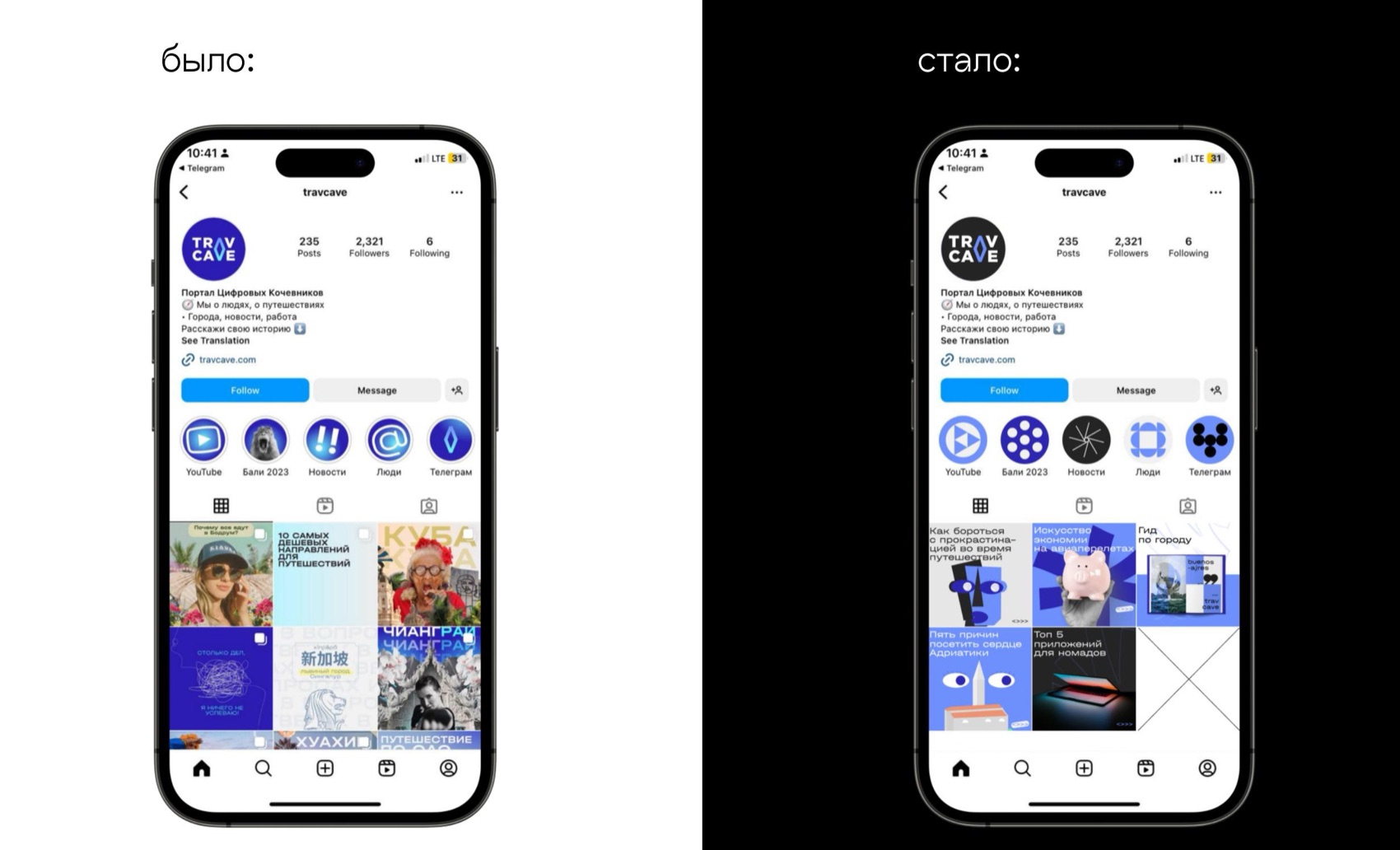 Before / after: same account, same follower count — a feed that finally looks like one product
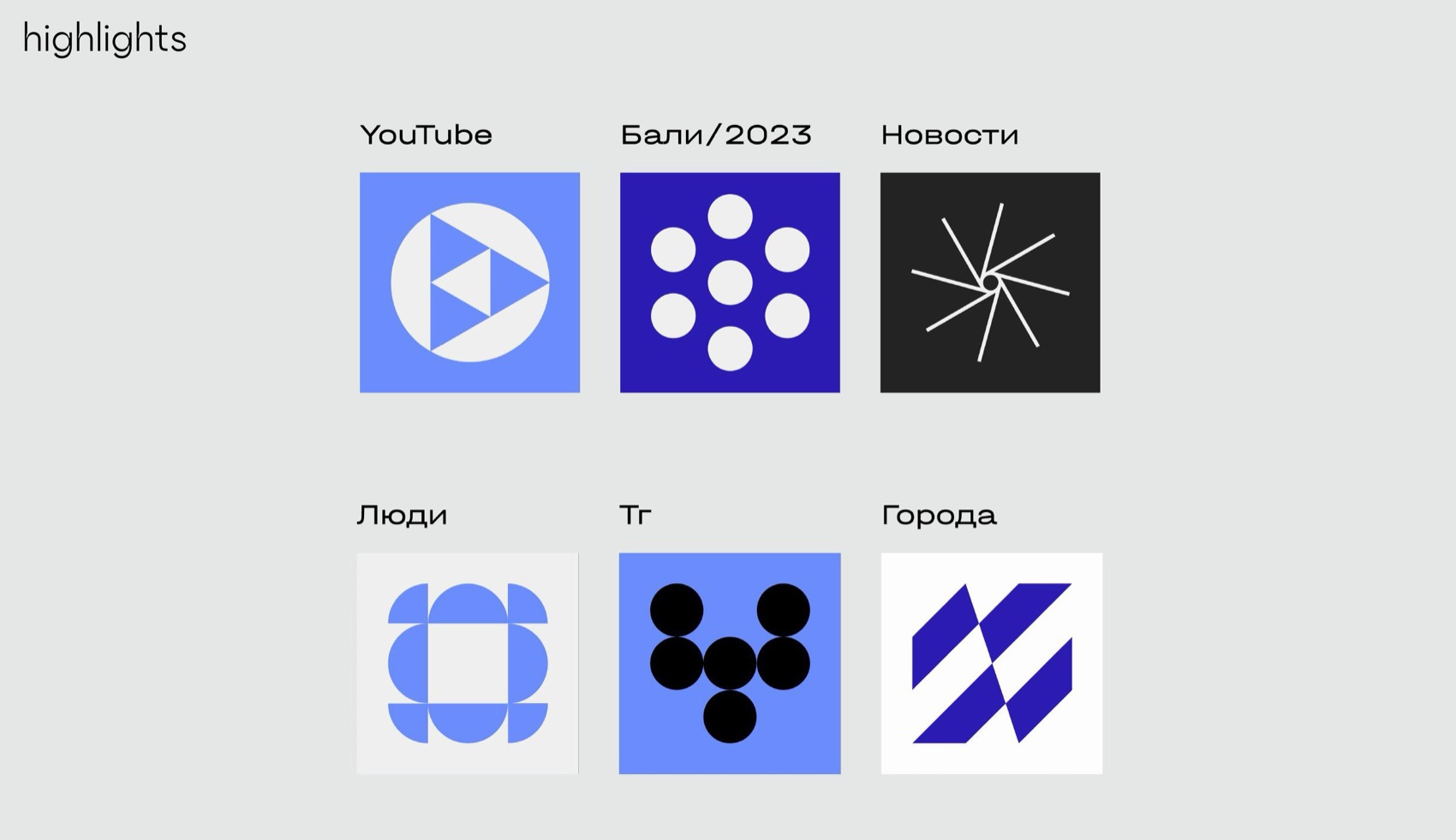 Highlight icons cut from the same geometric language as the wordmark’s diamond
The system shipped — the redesigned feed ran on the live account and was surfaced on the site itself through an Instagram strip on the homepage.
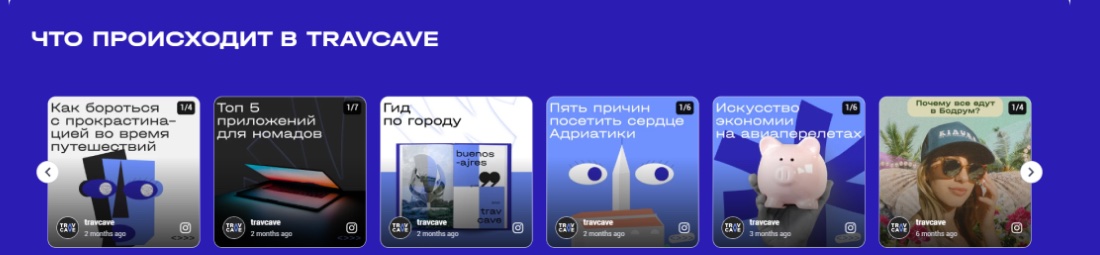 The redesigned feed, live — pulled into the portal’s homepage as social proof
TravHouse: shipping a real-world product
TravHouse was the experiential arm — recurring coliving/coworking trips combining remote work, skill-sharing, wellness and professional video production. The digital side was an acquisition funnel at trip.travcave.com: explain the format, take applications, run mini-interviews, select the group. Our founder led requirements and worked with a Russian creative agency to get the landing experience live in roughly a month — the runway available before the first trip.
TravHouse Bali ran February 1 – March 1, 2023: four weeks in a private villa with individual rooms, fast internet, a pool and a chef. The original model called for ten participants (five men, five women); after dropouts, the trip went ahead with six — dates kept, format adapted rather than cancelled. That decision was very much the point of the experiment: prove that a nomadic setup doesn’t stop people from working seriously.
The programming mixed self-organized coworking with participant presentations, invited specialists from business, marketing, psychology and IT, group brainstorms, Kundalini yoga, surfing in Kuta, a food tour in Canggu, excursions like Parq Ubud, parties and a planned closing hackathon — attendance flexible by design.
The trip was also a media production. Two camera operators documented daily life; full episodes were scheduled for Sundays on the TravCave YouTube channel, lectures and villa presentations published midweek, Reels and Telegram updates in between. Our founder handled the packaging end to end — titles, descriptions, participant attribution, discoverability keywords, and English and Spanish adaptations of the episode copy to test reach beyond the Russian-speaking core.
TravHouse Bali on the TravCave channel — introductions, the villa, and the first week of the experiment
Nomad 2.0 and the product lab
The ecosystem kept spawning smaller products. Nomad 2.0 was a digital toolkit for nomads — travel secrets for finding cheap flights and housing, budgeting templates, savings strategies — designed as a branded digital product and lead magnet. An onward-ticket generator (ticket.travcave.com) solved the proof-of-return-ticket problem at border control. And during this period our founder prototyped an AI itinerary generator: a personalized Russian-language trip planner taking traveler type, destinations, dates, budget, interests, work schedule, internet requirements and dietary needs as inputs, with an eye toward connecting recommendations to Aviasales and Ostrovok booking links — early groundwork for the AI product work Startrise does today.
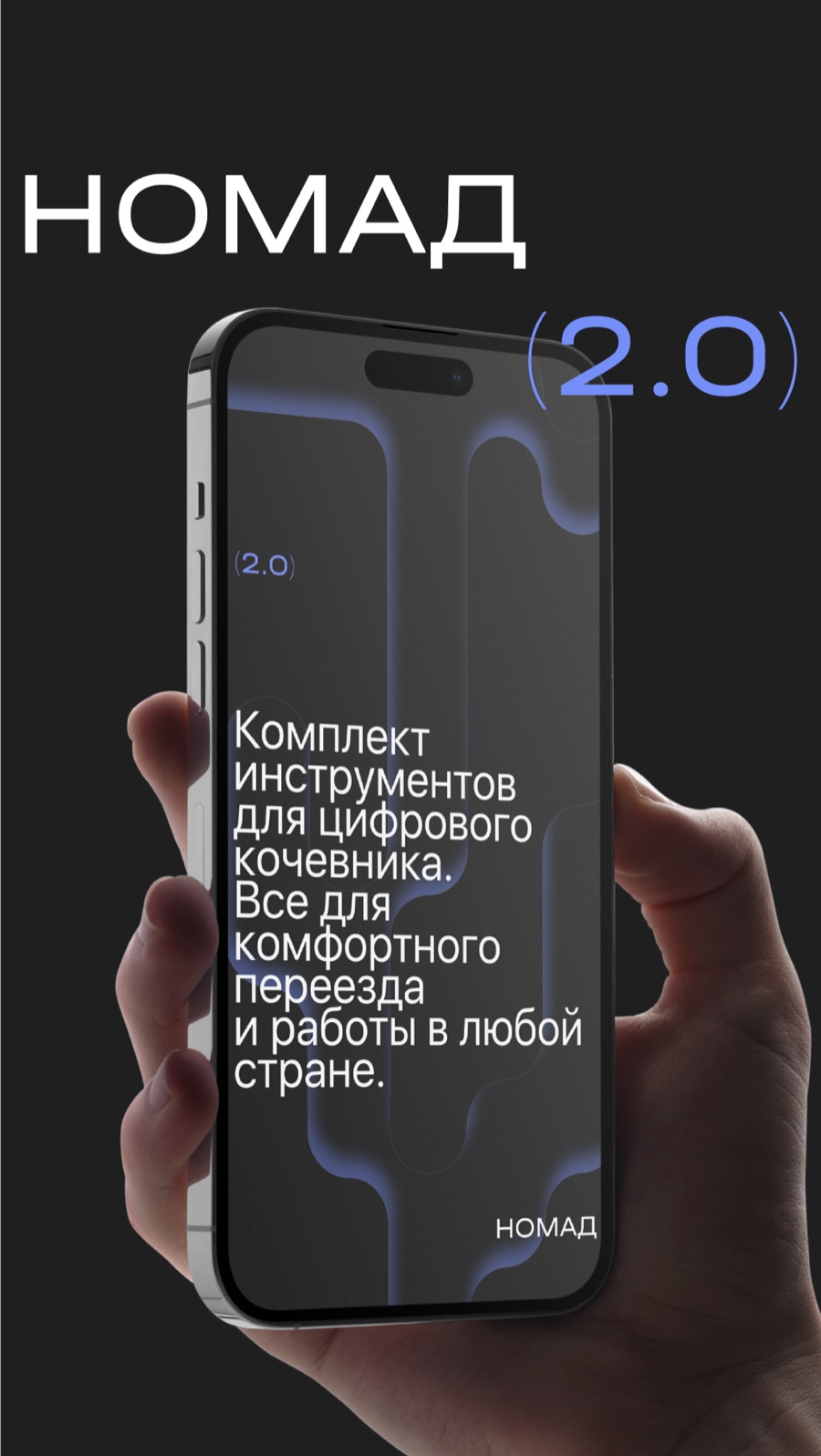 Nomad 2.0 — the toolkit as a designed product, not a PDF afterthought
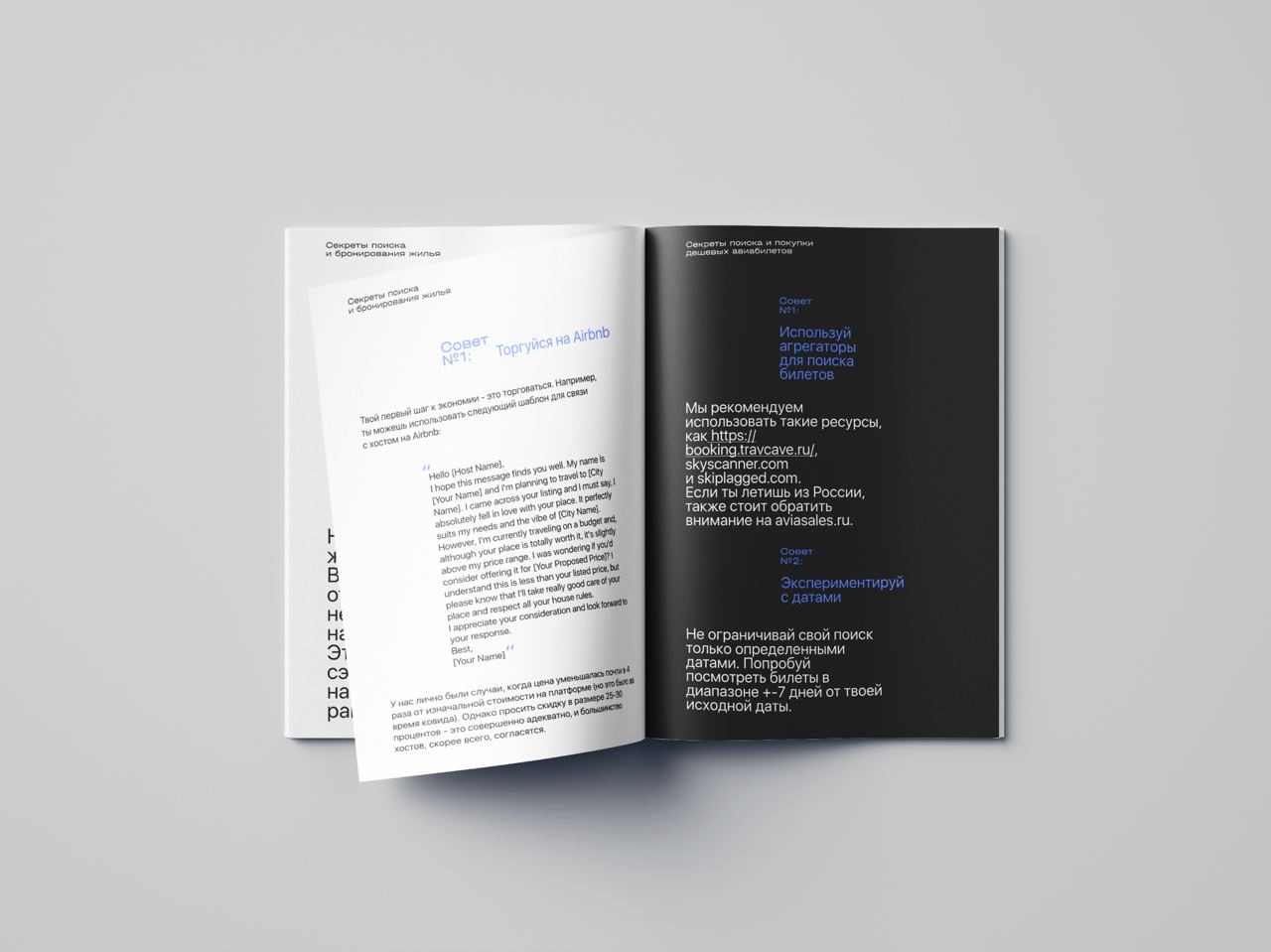 Interior spreads: travel secrets, flight-savings strategies, housing negotiation templates
The numbers
From the July 2024 media kit, covering June 2022 – July 2024:
- 432,000+ unique users and 2.2M+ page views
- 99.2% average growth against a 62.2% market average, with consistent outperformance over the final six months and a record traffic peak in April 2024
- 48.3% of visits from organic search — at a 7.42% bounce rate, the SEO traffic was actually the right audience
- 38.6% direct visits — people came back on their own
- 79.4% mobile, core audience 25–34, most-engaged segment 35–44 (2:30 average time on site)
- Readers in Russia, Thailand, Kazakhstan, Germany and Ukraine — the geography of the diaspora it was built for
Why this one matters
TravCave is in this portfolio because it’s proof of the full loop: strategy, brand, custom engineering, third-party integrations, SEO, analytics, content operations, social systems, physical events and video production — run by one founder-led team on startup resources, and grown to nearly half a million users. When Startrise builds a product for you, this is the operating experience behind it: we’ve had to make every one of these decisions with our own money on the line.
Technical stack
- Platform: Custom WordPress theme (
travcave-buddyboss), PHP templates with custom front-page logic, Advanced Custom Fields, custom Gutenberg blocks, BuddyBoss community layer - Frontend: Custom JavaScript/AJAX, GSAP, Glide.js, VenoBox, YouTube IFrame API, self-hosted HTML5 video, responsive CSS
- Data & integrations: Structured city entities (cost, rent, internet speed, check-ins), OpenWeather grouped API with transient caching, Aviasales white-label booking
- SEO & analytics: Dynamic hotel-page metadata (title/description/OG/Twitter, Russian locale), GA4 with custom video-engagement events via
gtag() - Infrastructure: DevKinsta, Docker, Nginx local environment
- Brand: Halvar Breitschrift + Gotham Pro type system, Instagram grid/carousel design system, highlight iconography