

Editorial network — Full AI automation (PBN)
An n8n-orchestrated content factory — generate, humanize, illustrate, publish — scaled to five websites with almost no human time per post.
- Client
- Confidential — media operator
- Sector
- Digital publishing · Programmatic content
- Scope
- Automation architecture · AI pipeline engineering · Multi-site operations
- Team
- One engineer, one operator
- Timeline
- Pipeline built and tuned in weeks — then scaled site by site to five.
The network's domains stay unnamed. The workflow shown is the production n8n canvas.
Discuss your projectContent sites live or die on volume and consistency. A human editorial team produces a handful of decent posts a day, costs real money, and gets tired. Our client wanted the opposite curve: a network of niche editorial sites where output scales with compute, not headcount — and where one operator can run the whole thing from a queue.
We built that as a single n8n-orchestrated pipeline, then cloned it across the network. It grew to five websites publishing around the clock, with capacity for a thousand posts a day and a first-two-weeks traffic curve that crossed 30,000 visitors.
The assembly line
Every article moves through the same stations, fully unattended:
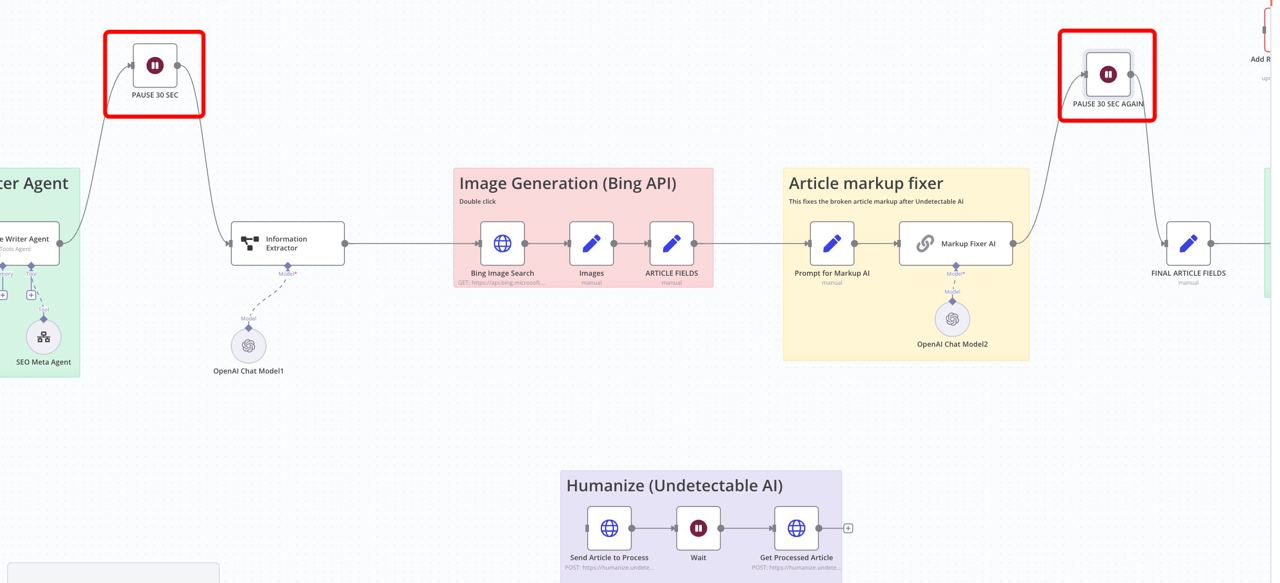
The production canvas — agents on the left, image and markup stations in the middle, the humanizer loop below
1. Topic intake. Each site owns a keyword and topic queue built from its niche’s search demand. The queue is the only thing a human curates — everything downstream is automatic.
2. Writing agents. A Writer Agent drafts the article; a dedicated SEO Meta Agent works alongside it, producing titles, descriptions, and slugs against the target query. Splitting the two kept both jobs sharp — prose stays readable, metadata stays disciplined.
3. Structured extraction. An Information Extractor pulls the draft apart into clean, typed article fields — headline, body, excerpt, category, image search terms — so every later station works with structured data instead of a blob of text.
4. Humanization. The draft passes through Undetectable AI in an async loop — send, wait, poll, retrieve. Machine-flavored phrasing goes in; natural-sounding copy comes out.
5. Markup repair. Humanizers are great at prose and terrible at HTML — they routinely mangle headings, lists, and links. A dedicated Markup Fixer AI station repairs the article’s structure after humanization, so what reaches WordPress is valid, well-formed markup every time. This one station removed the single biggest source of broken published pages.
6. Imagery. Image search terms from the extractor drive Bing Image Search; results are fetched, attached to the article fields, and set as featured images. No post ships bare.
7. Final assembly and publish. All fields converge into the final article record and go out through the WordPress REST API — post, metadata, taxonomy, featured image — on a publishing schedule tuned per site so output looks like a living editorial calendar, not a bot dump.
The unglamorous parts that made it work
- Rate-limit choreography. The bright red pauses on the canvas are deliberate 30-second holds between API-heavy stations. Third-party AI services throttle aggressively at volume; pacing the pipeline beat retry storms every time.
- Queueing and backpressure. At 1,000 posts/day across five sites, everything is a queue. Articles wait their turn at each station, failures re-enter the line, and no single slow API stalls the network.
- QA gates and rollback. Spot-check gates sample output quality, and bad batches can be pulled back — at this volume you don’t proofread posts, you manage failure rates.
- Per-site configuration. Each of the five sites is the same pipeline with its own niche, keyword queue, tone settings, publishing cadence, and WordPress target. Standing up site five took a fraction of the effort of site one.
- Delivery. CDN and caching in front of every site, so traffic spikes from ranking pages never touch origin performance.
What one operator’s day looks like
Feed the topic queues. Glance at the QA samples. Clear the rare failed batch. That’s the entire human footprint — under five minutes per hundred posts — which is the real product: an editorial network whose marginal cost per article is API calls, not salaries.
What shipped
- A full n8n content pipeline: dual writing agents, structured extraction, humanization loop, markup repair, automated imagery, SEO metadata, scheduled WordPress publishing
- Five production websites running the pipeline with per-site configuration
- Queue-based throughput management with rate-limit pacing, QA sampling, and rollback
- 1,000 posts/day capacity, 30k+ visitors in the first 14 days, <5 min operator time per 100 posts
Technical stack
- Orchestration: n8n — agent nodes, async loops, per-site workflow clones (why we chose n8n over a code-first framework like Mastra)
- AI: OpenAI models for writing, SEO metadata, extraction, and markup repair; Undetectable AI for humanization
- Imagery: Bing Image Search API pipeline
- Publishing: WordPress REST API, scheduled multi-site delivery
- Automation & QA: Puppeteer-based checks, sampling gates, rollback
- Infrastructure: CDN and caching in front of all five sites